A quartz crystal at 49,152 cycles a second, divided down to drive an electro-mechanical balance; then, in 1974, a liquid crystal display.
Quartz1972–1974LCD
Model 62 · Electronic Regulation Device
Model 6212¾ ligne · 28.7 mm · calendar
Model 6313½ ligne · 30.5 mm · day-date
Model 93Liquid crystal digital
Crystal49,152 Hz (62, 63) · 32,768 Hz (93)
Beat21,600 per hour (62, 63)
PowerEnergy cell Type A (62, 63) · Type D (93)
AccuracyWithin 15 seconds a month
SourceService Bulletins 103, 103A, 106, 109
Timex Goes Quartz
Timex introduced its quartz watch in March 1972 with the Model 62, followed by the Model 63 and, in March 1974, the Model 93 with a liquid crystal digital display. None of the three has a factory service manual in the collection; everything here comes from the service bulletins that announced them.
A micro computer system containing a quartz crystal and over 300 transistors controls its timekeeping accuracy to within 15 seconds a month. The quartz crystal vibrates at a frequency of 49,152 cycles per second. It is this high frequency quartz crystal which enables the watch to maintain superior accuracy. This frequency is divided down to 6 cycles per second by the integrated circuit in the micro computer and is used to control the vibration rate of an electro-mechanical balance at precisely 6 beats per second. The electro-mechanical balance drives the dial train through an index lever and index wheel.
The watch is powered by a Timex Energy Cell. For best timekeeping, the cell should be changed every 12 months, using only genuine Timex Energy Cells. Use of an energy cell not meeting Timex watch cell specifications may cause the watch to malfunction.
Factory service only, at first: the first bulletin (No. 103, March 1972) states that proper servicing of the micro computer system requires special electronic equipment available only at the Timex factory, so initially no service was to be performed in the field. The revised bulletins for the Models 62 and 63 (No. 103A and No. 106) allow a watch with a minor timekeeping error, less than 3 seconds a day, to be regulated using a rate recorder as described below. A major error, more than 3 seconds a day, or any other service still went back to Timex at Little Rock, Arkansas, at no charge during the guarantee period.
Model 62 · Quartz Calendar
The Timex Model 62 is a 12¾ ligne men’s quartz calendar watch: 28.7 mm (1.13 inch), 21,600 beats per hour, powered by a Timex Type A Energy Cell.
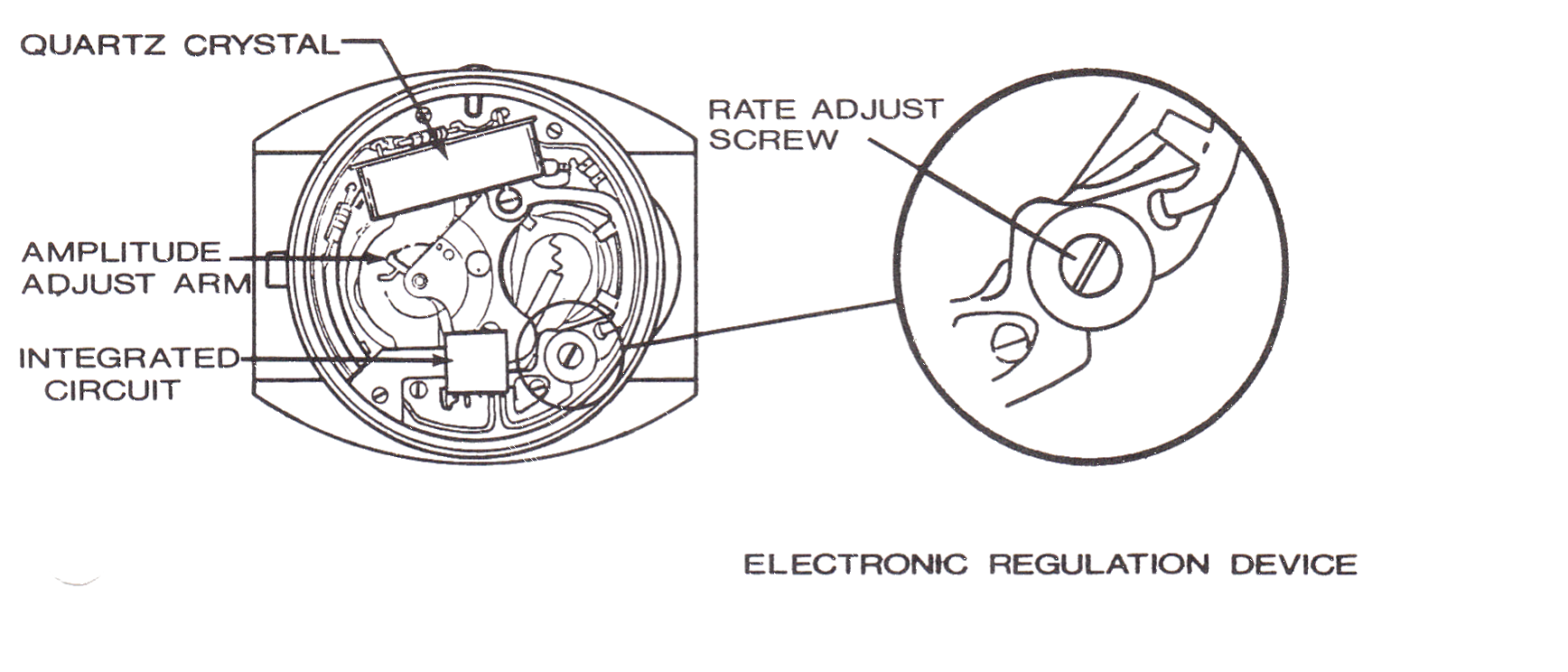
View with case back and energy cell removed · Service Bulletin No. 103A
Timekeeping is regulated by rotating the “rate adjust screw” of the electronic regulation device. The direction of the rotation to correct a specific timekeeping error must be determined by trial and error during regulation.
A special case closing tool must be used to close the case when servicing a Timex Model 62. This special tool could be obtained from the Timex Repair and Service factory.
Model 63 · Quartz Day-Date
The Timex Model 63 is a 13½ ligne men’s quartz day-date watch: 30.5 mm (1.20 inch), 21,600 beats per hour, powered by a Timex Type A Energy Cell.
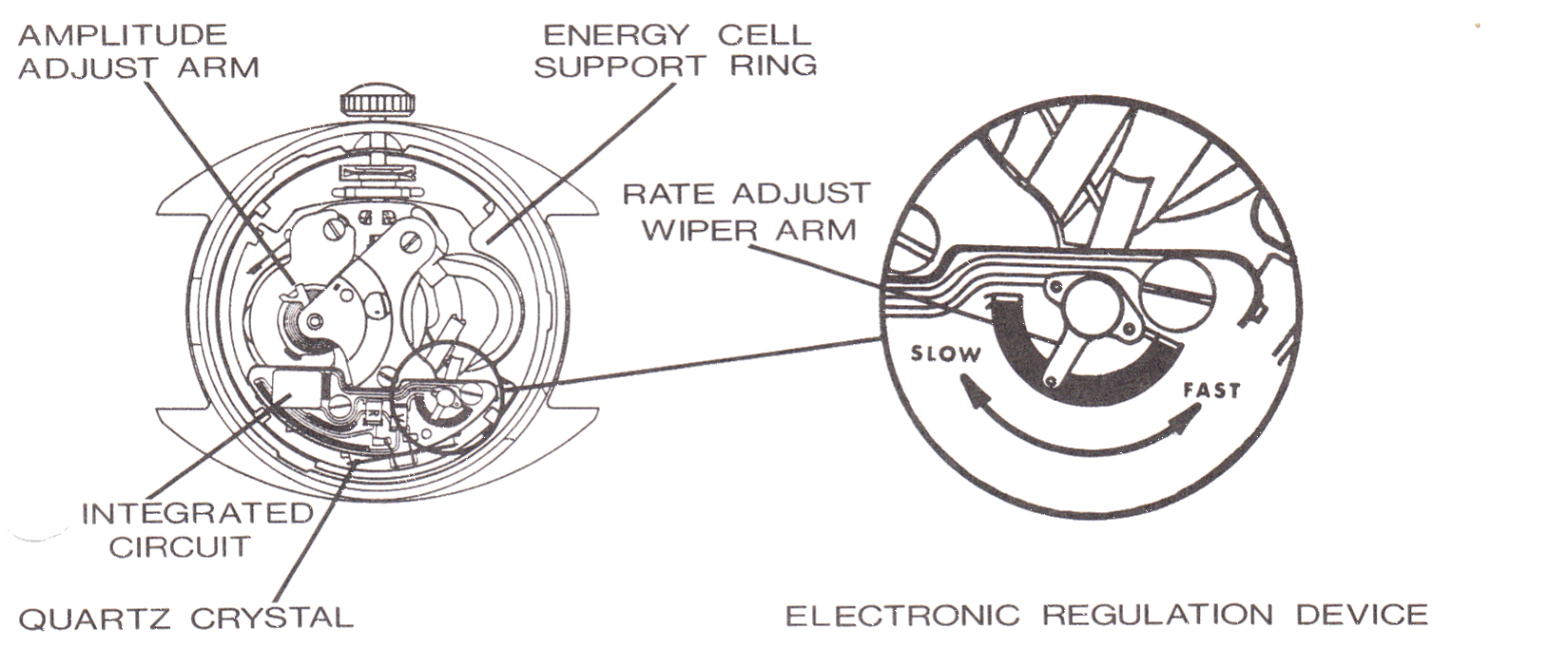
View with case back and energy cell removed · Service Bulletin No. 106
Timekeeping is regulated by rotating the “rate adjustment arm” (the rate adjust wiper arm). A clockwise rotation will give a slower rate. A counterclockwise rotation will give a faster rate.
Regulation Using a Rate Recorder
Models 62 and 63. The procedure is the same for both; where they differ, it is noted.
I. Equipment
It is preferable to use a rate recorder having a vernier scale with ½ second divisions (example: Vibrograph B-500). However, a conventional rate recorder is adequate provided particular care is taken to accurately align the recorder scale with the trace on the recorder tape. The Model 62 also needs its special case closing tool.
II. Electronic Regulation Device
On the Model 62, timekeeping is regulated with the rate adjust screw; on the Model 63, with the rate adjustment arm (clockwise slower, counterclockwise faster).
Caution: do not change the position of the “amplitude adjust arm”. This arm will not regulate the timekeeping. Rotation of this arm will only affect the balance amplitude.
III. Regulation Procedure
A conventional rate recorder may not accurately indicate a watch rate to the exact second. Therefore, a rate must be determined which compensates for recorder inaccuracy and that will be used as a reference for regulating the quartz watch to a zero rate.
A. Set the watch to the exact second and after a run of at least 3 days, determine what correction must be made in the daily timekeeping rate. Since accuracy is important, timekeeping should be determined using a time standard based on Greenwich Mean Time.
3 day total error
Daily error
Daily rate correction required
Example 1
+4½ sec
+1½ sec
−1½ sec
Example 2
−3 sec
−1 sec
+1 sec
B. Remove the case back and with the energy cell in place, check for a stable and adequate balance amplitude (270°). Then run the watch on the rate recorder in the dial down position for at least 3 minutes. Use the rate indicated to determine a reference rate as in the examples below. Then adjust the watch to a zero rate by rotating the rate adjust screw (Model 62) or rate adjust wiper arm (Model 63) in the appropriate direction until the rate recorder indicates the reference rate.
Rate indicated by recorder
Daily rate correction (from A)
Reference rate (adjust watch to this rate)
Resulting watch rate
Example 1
+5 sec/day
−1½ sec/day
+3½ sec/day
0
Example 2
−4 sec/day
+1 sec/day
−3 sec/day
0
C. Replace the case back (on the Model 62, with the special case closing tool). Then rerun the watch for 3 days minimum and recheck the daily rate. The timekeeping error should not exceed ½ second per day.
Caution: do not place the watch under a high intensity light when checking or adjusting rate. The electronic circuit may be temporarily affected, resulting in erroneous rate readings.
Lubrication: Service Bulletin No. 111 (June 1974) specifies Moebius Synt-A-Lube oil instead of Elgin M56B oil for the Models 62 and 63. Bulletin No. 112 (July 1976) allows a spreading type lubricant (Woods AAAA oil) to be applied to dial rests with solid film lubricant, including the Model 62’s. See the Model 254 guide.
Model 93 · Liquid Crystal Digital
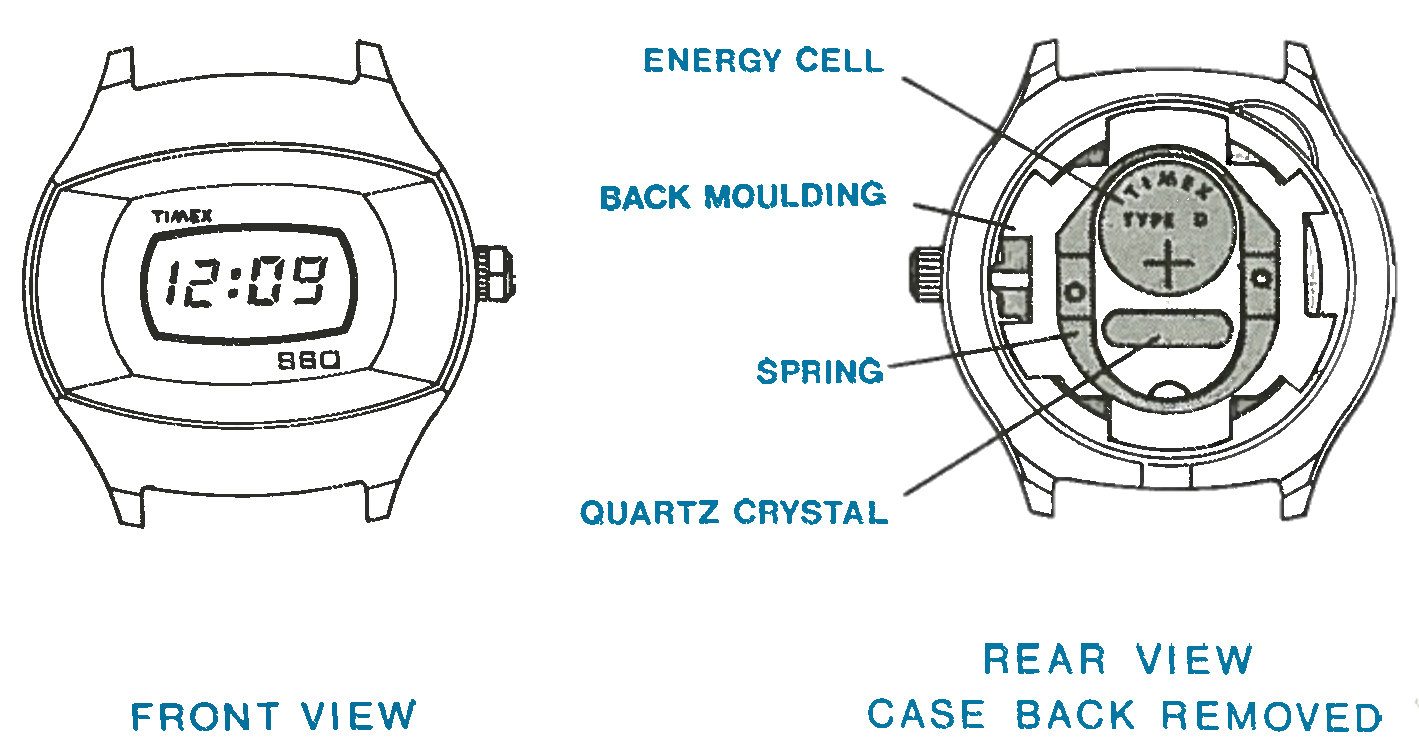
The Timex Model 93 is a men’s solid state electronic watch with a liquid crystal digital time display. The timekeeping is controlled by the quartz crystal to an accuracy within 15 seconds a month (adjustment may be necessary to achieve this accuracy).
Front view, and rear view with the case back removed · Service Bulletin No. 109, March 1974
The quartz crystal vibrates 32,768 times per second and generates electrical impulses at that frequency. Complex electronic circuitry integrated on a small chip of silicon divides the crystal frequency down to 1 impulse per second. These impulses are counted by additional circuits on the silicon chip so that the minute display is advanced every 60 seconds and the hour display is advanced every 60 minutes.
Time in hours and minutes is shown by means of a liquid crystal display. A liquid crystal is a substance which pours like a liquid but has optical properties similar to a solid crystal. In a suitable arrangement, a thin layer of normally transparent liquid crystal material will appear opaque when subjected to an electric field. It is thus possible, with electrodes shaped into the form of numerals, to create dark digits on a light-reflecting background. The colon between the hour and minute display flashes continuously once per second to indicate that the watch is running.
The watch is powered by a Timex Energy Cell Type D, to be changed every 12 months.
Factory service only: proper servicing of the complex electronic and display system required special electronic equipment available only at the Timex factory. Initially, no service was to be performed in the field; the watch was returned to Timex at Little Rock, Arkansas.