Decode any code found on your Timex — the case-back stamp, the dial code, or the model number. The system detects the era and decodes everything it contains.
Enter the case-back stamp, dial code, or model number. We detect the era and decode the year, month, catalog number, movement, and series.
Where to find the code
1985 – Present
Where — Case Back
1–2 character alphanumeric code stamped on the outside of the case back. Gives year and month only.
e.g. K4, AB, V3
1963 – 1984
Where — Dial Face
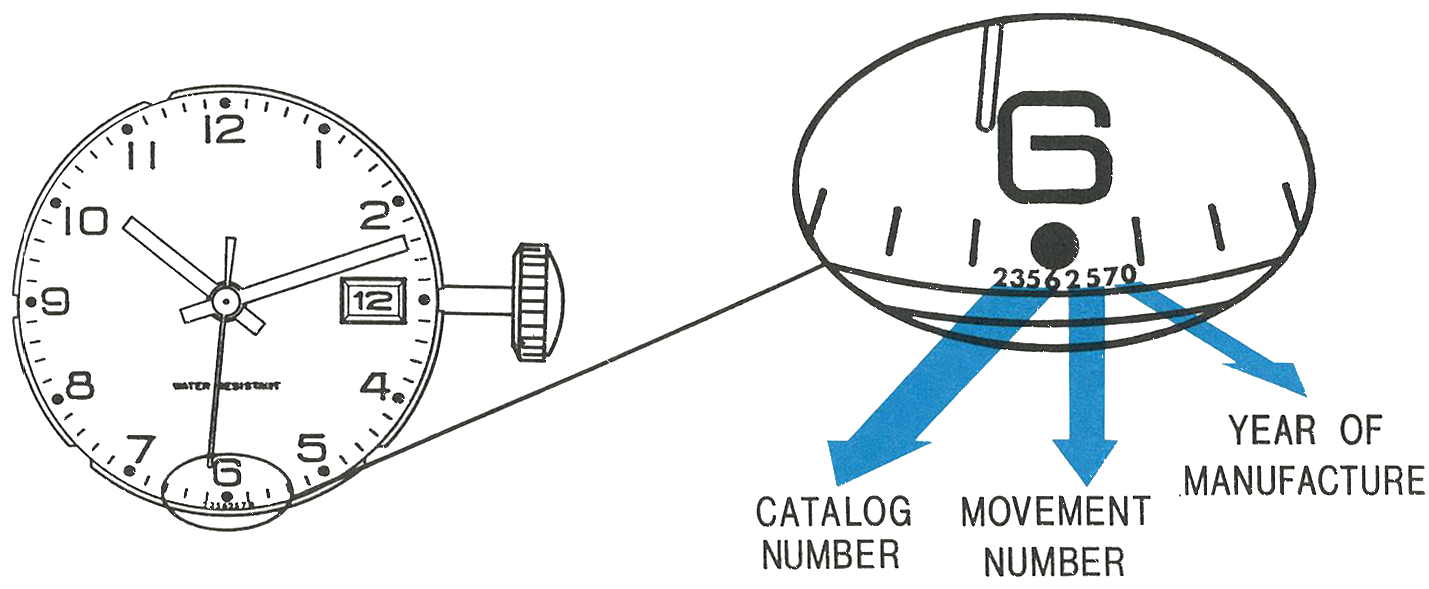
8–10 digit number printed on the dial face, under the movement. Not visible until the case is opened. Gives catalog number, movement, and year.
e.g. 23562570, 2355002574
Pre-1963
Where — Inner Case Back
Ink stamp on the inside of the case back — gives the last two digits of the year or the full year. May have rubbed off if serviced.
e.g. 57, 1957
Enter the two-character code stamped on the case back (1985–2014). Identifies year and month of production.
Enter a code to identify your watch
How the Code Works
1985–1992 use two digits (01–96, one per month across the year). From 1993 a letter prefix marks the year (A=1993, B=1994 … N=2005) followed by the month digit. From 2014 the code resets to single digits.
Each digit in a pre-1985 model number describes a physical property: the first two identify the series, then bezel, hand/dial, and band.
Enter a 5-digit model number
Digits 1–2 · Series
1949 – 1963
Inner Case Stamp
Most often during this period, you can find a stamp within the inner case back that will give you either the last two digits of the year, the full year, or a month and year of manufacturing. In some cases, especially if the watch has previously been serviced or parts replaced, this ink stamp may have rubbed off. Once you find the year, go to the Model Reference section of this site for more information on models within that year.
1963 – 1970
8-Digit Dial Code
From 1963, Timex printed a code on the dial face — catalog number (4 digits), movement number (2), and year (2). Example: 23562570 — catalog 2356, movement Model 25, 1970. If you cannot see it, it is hidden under the crystal and bezel and the case must be opened — see Case Construction.
1971 – 1973
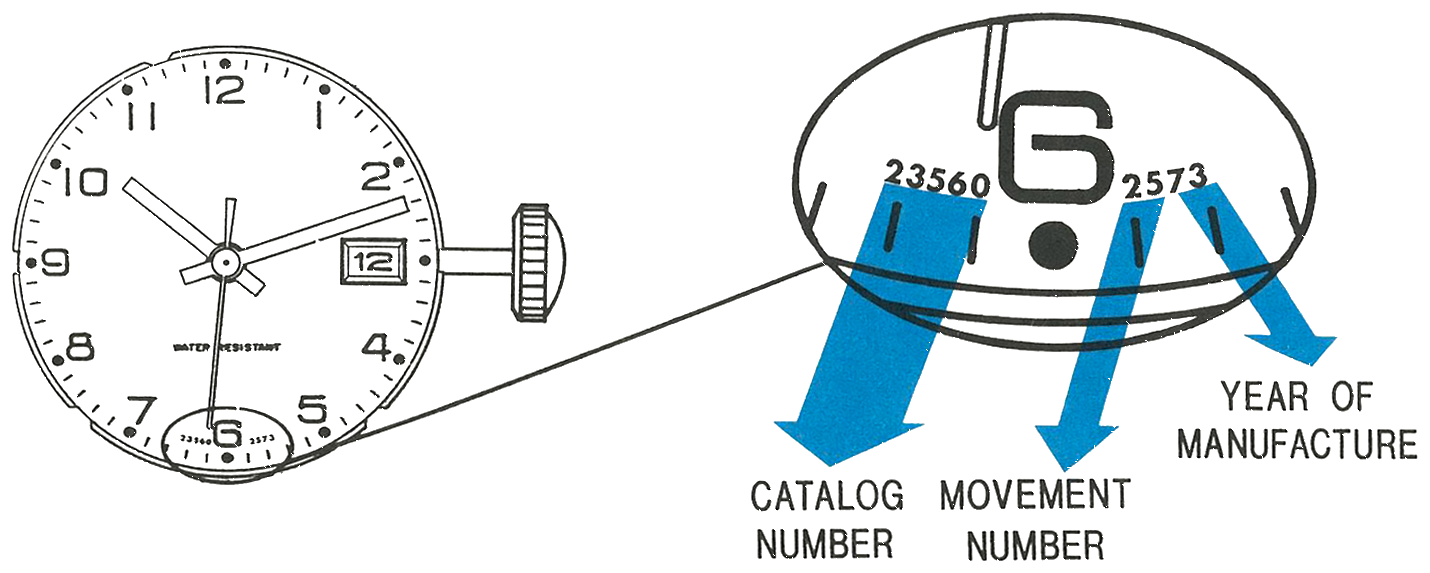
9-Digit Dial Code
The catalog number expanded to five digits (including the strap/band variant). Example: 235602573 — catalog 23560, movement 25, 1973.
1974 – 1984
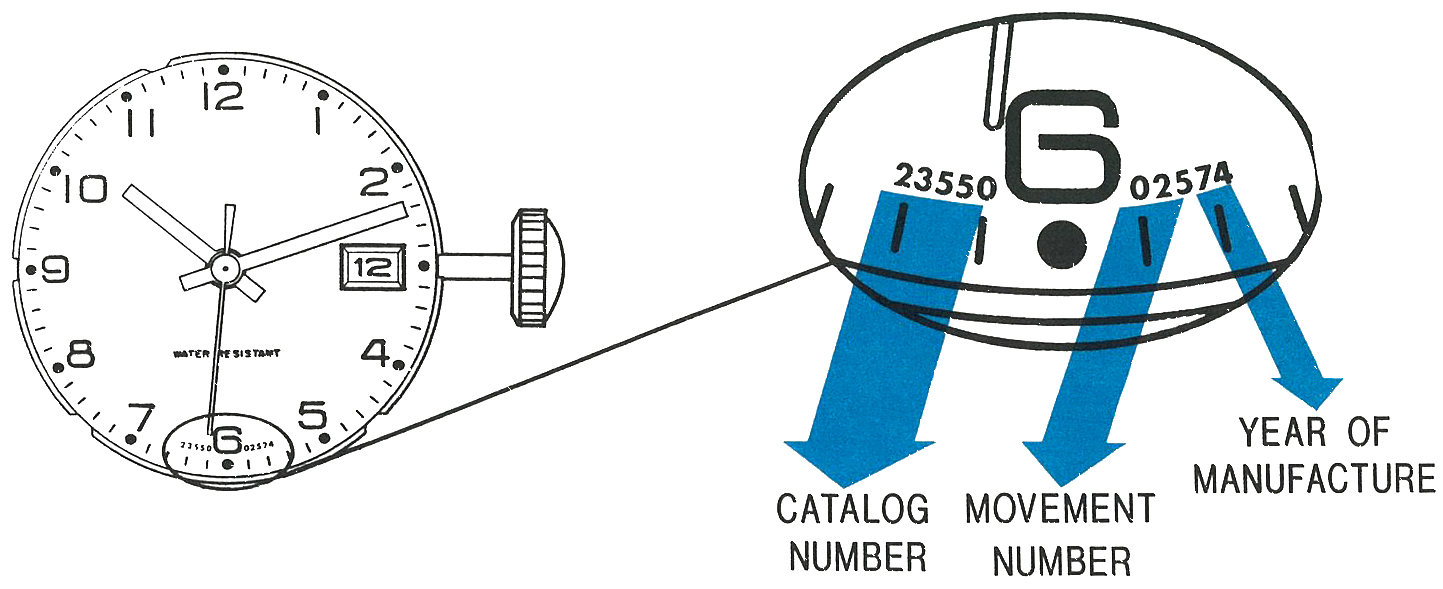
10-Digit Dial Code
Movement numbers expanded to three digits as the lineup grew. Example: 2355002574 — catalog 23550, movement Model 25, 1974.
UK-market Timex watches (the dial often reads “Great Britain” or “United Kingdom”) used two parallel identification systems up to 1967: a numeric model number and a mnemonic letter code. Both describe the series, bezel plating, dial and sweep second hand. From 1967 an eight-digit code on the dial replaced both: catalogue number (digits 1–4), movement (5–6) and year (7–8). British watches made before 1967 have no code on the dial. The same model number can mean a different watch in the UK and the US: UK 2125 is a Timex Marlin Calendar.
Some models carry 1, 6, 8 or 9 as the fourth digit; the catalog lists those on their own series pages.
Letter code · first letter · series
An "X" after the first letter means gold plated; no "X" means chrome plated. The next letter gives the dial and hands. An "S" after it means a sweep second hand; calendar models carry "C" instead.
Letter code · dial and hands
Case back · year of manufacture · 1959–1967
A code of one letter and one number is stamped inside the case back. The number gives the year; the catalog does not say what the letter means.